
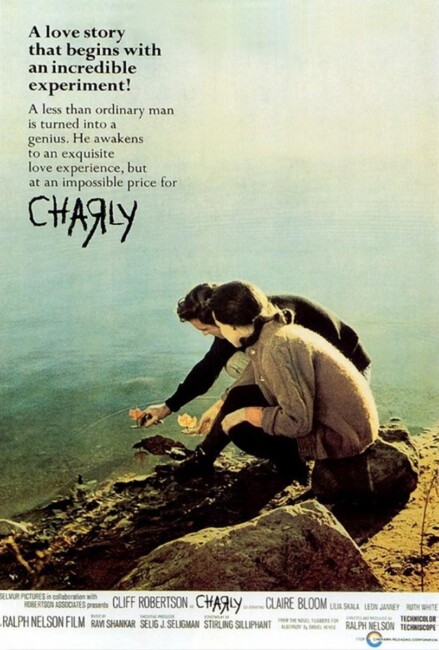
Crew
Director – Ralph Nelson, Screenplay – Stirling Silliphant, Based on the Short Story Flowers for Algernon by Daniel Keyes, Producers – Ralph Nelson & Selig J. Seligman, Photography – Arthur Ornitz, Music – Ravi Shankar, Makeup – Vincent Kehoe, Art Direction – Charles Rosen. Production Company – Selmur,
Cast
Cliff Robertson (Charly Gordon), Claire Bloom (Alice Kinian), Lilia Skala (Dr Anna Strauss), Leon Janney (Dr Richard Nemur), Ed McNally (Gimpy)
Plot
Charly Gordon, a bakery worker with an IQ of only 59, is selected as a test-subject for a pioneering experiment in intelligence enhancement. The experiment is successful and Charly rapidly progresses in learning until he becomes a genius. However, his emotions lag considerably behind. After his primitive advances are rejected by his teacher Alice Kinian, Charly becomes a social dropout. He returns and Alice accepts him. He then learns that the effects of the experiment are starting to reverse themselves.
Daniel Keyes’ novella Flowers for Algernon (1959) was an instant classic from the time of its publication. It won the science-fiction community’s Hugo Award that year and Daniel Keyes’ full-length novelization of the story also won the 1966 Nebula Award. Cliff Robertson, then a novice actor, purchased the rights to the story and personally shepherded it through to filming, first playing the role in a tv play version The Two Worlds of Charlie Gordon (1961) that aired on The United States Steel Hour, which saw him nominated for an Emmy Award. One can see what drew Robertson to make such personal investment in the project – Charly is a choice actor’s role. The Best Actor Oscar awarded for to Cliff Robertson for his efforts that year was deserving.
The script was adapted by Stirling Silliphant. This was at the point when Stirling Silliphant was fresh from Village of the Damned (1960) and winning an Oscar for In the Heat of the Night (1967) and brimming with talent and before he sank to the flabby lure of churning out scripts for Irwin Allen’s disaster movies like The Poseidon Adventure (1972), The Towering Inferno (1974), The Swarm (1978) and When Time Ran Out/The Day the World Ended (1980).
The visual medium necessarily lessens the impact of Daniel Keyes’ story. The story was told entirely as a series of diary entries where you could understand the growth in Charly’s intelligence through the gradual erudition of syntax and spelling. This is something the film unavoidably has to abandon. However, while it is only a mixed success, one cannot fault Charly for trying hard.
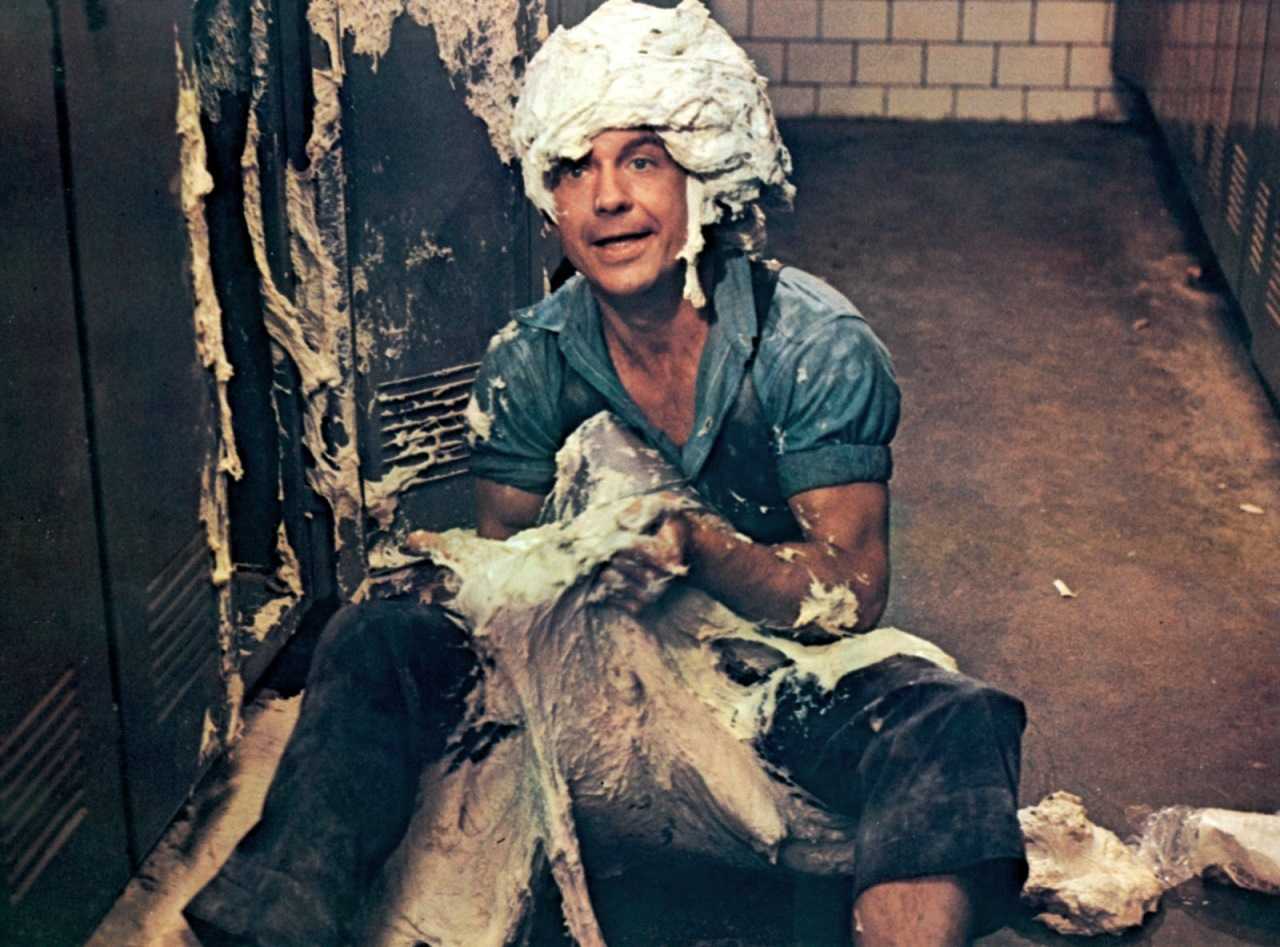
When Charly is successful it is mostly due to the intensely heartfelt performance from Cliff Robertson. Compare Cliff Robertson’s performance here to another close example, the part Robert De Niro played in Awakenings (1990). There De Niro is simply playing De Niro playing a patient; not something that one can say for Cliff Robertson. This is a performance that starts deep down inside and comes out reflected through every nuance. The pictures of Robertson as the intellectually handicapped Charly – the way he is cruelly treated by his co-workers and plays along, laughing with the joke without understanding why everyone is laughing – are emotionally hitting.
The film’s last image of the police car pulling away, leaving Cliff Robertson against the street-lamp is tremendously heart-wrenching. Director Ralph Nelson shoots with a gritty realism that works surprisingly well for the film. He has a marvelous sense of dramatic construction – the scene where Cliff Robertson finally beats Algernon is indeed a triumphant one.
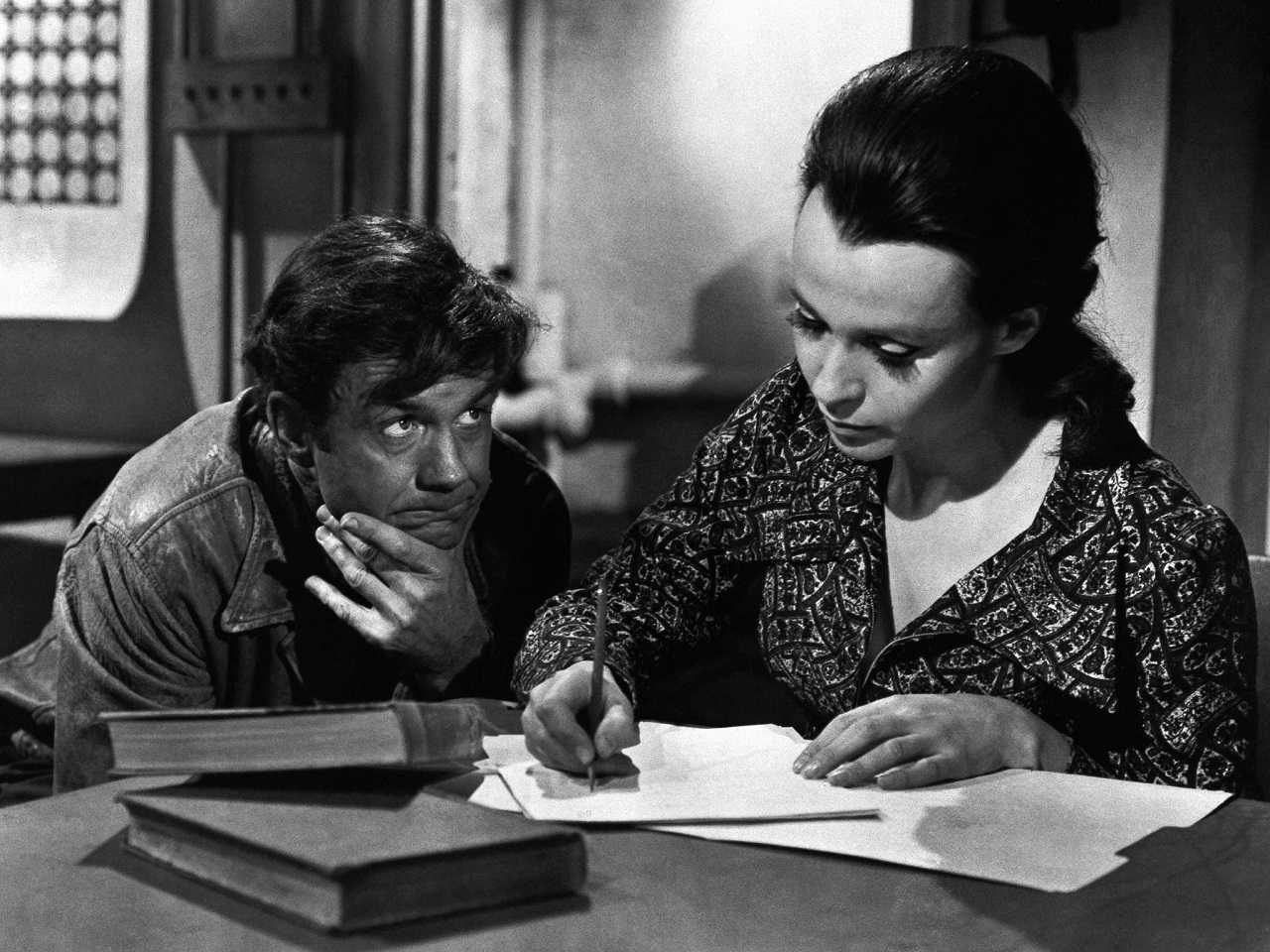
Where the film falters is in etching the genius side of Charly. The film has less of an emotional affinity for these scenes than it does with the scenes of the retarded Charly – here Cliff Robertson seems distant and the scenes are cursorily directed. In these parts, Stirling Silliphant adds a romantic subplot and here the film varies the most from the original story. The motivations get muddied – there hardly seem adequate reasons for the firing of Charly from the bakery; and Claire Bloom’s changing her mind to sudden love after Charly’s attempted rape of her, inexplicably abandoning her fiancee and turning from a starchy white-coat to a fun-loving flower-child, is not psychology that rings true.
The worst part in the whole film is the sequence where Cliff Robertson runs away and becomes a biker – wearing a fake beard and a leather jacket embossed, would you believe, ‘Charly Baby’, while smoking dope in a series of split-screen montages, one panel of which announces that smoking is bad for one’s health.
The end of the film inexplicably throws away the most heart-wrenching part of the original story where we saw Charly regressing back to a simpleton again. Instead, the film substitutes a heavy-handed lecture against science and an unnecessary sequence where genius Charly imagines himself facing the retarded Charly, before abruptly ending on an absurdly mannered scene where Cliff Robertson merely bids goodbye to Claire Bloom. The ending Daniel Keyes wrote would have been great, seeing Charly retarded once again struggling with the idea of his oncoming death and to remember and understand the person he used to be.
Charly was remade as a tv movie Flowers for Algernon (2000), starring Matthew Modine as Charly. This was far more accurate to the original story but laid everything over with mawkish sentiment. There was also a further Swiss made tv adaptation in 2006 starring Julian Boisselier.
Director Ralph Nelson was known for other dramas of the era such as Lillies of the Field (1963), Fate is the Hunter (1964) and Soldier Blue (1970). Nelson later returned to the science-fiction genre with Embryo (1976), a dull drama about an artificially birthed woman.
Full film available here