

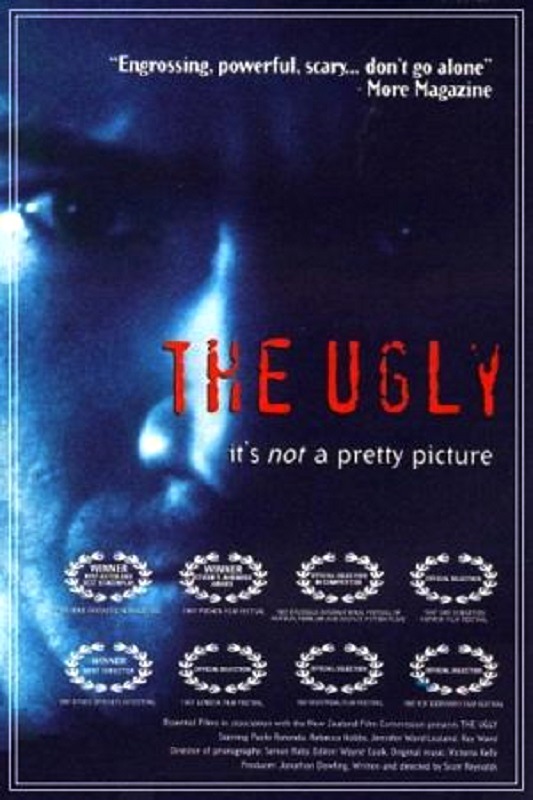
Crew
Director/Screenplay – Scott Reynolds, Producer – Jonathan Dowling, Photography – Simon Raby, Music – Victoria Kelly, Visual Effects – WETA Digital FX (Supervisor – John Shiels), Makeup Effects – WETA FX Ltd (Supervisor – Richard Taylor), Production Design – Grant Major. Production Company – Essential Films/The New Zealand Film Commission.
Cast
Paolo Rotondo (Simon Cartwright), Rebecca Hobbs (Dr Karen Shoemaker), Roy Ward (Dr Marlowe), Paul Glover (Phillip), Christopher Graham (Robert), Jennifer Ward-Leland (Evelyne Cartwright), Vanessa Byrnes (Julie), Sam Wallace (Young Simon), Beth Allen (Young Julie)
Plot
Psychologist Karen Shoemaker is sent to an asylum to conduct an assessment of serial killer Simon Cartwright. In a series of interviews, Simon takes her through his past growing up with an abusive mother and talks of an unrequited love for a childhood girlfriend. At the same time, he blames the killings on an identity he calls The Ugly and tells her that the ghosts of his victims, whom he names The Visitors, urge him to kill further. As the asylum’s director urges Karen not to believe anything that Simon says, she tries to earn his trust and break through to understand what drives him to kill.
One always celebrates the appearance of new director who has clear ambitions. Seeing for the first time the work of a John Carpenter, a Stuart Gordon, a Sam Raimi, a David Lynch, a Peter Jackson, or even something like Steven Spielberg’s Duel (1971) – there is always the thrill of seeing a talent that one knows is going places. Unfortunately, there can also be a downside to this – many directors enter with a hubris and a certainty that they are capable of conquering the world with their film and a failure to realise any shortcomings. Debuting director Scott Reynolds clearly belongs to the latter category with The Ugly. One cannot deny that Scott Reynolds has ambitions – but whether he achieves them in The Ugly is an altogether different question.
There is a great deal of potential to the set-up of the psychologist interviewing the disturbed killer – The Silence of the Lambs (1991), which is the film’s clear source of influence, and tv’s Cracker (1993-6) have milked the simple set-up of the two sitting across from each other in a cell for considerable dramatic potential in recent years. Unfortunately, Scott Reynolds fumbles the idea. He seems so distracted by playing visual tricks throughout that he forgets that the drama of such an idea lies in turning it into a detective story – a whydunnit – exploring the psychology and the inherent tension in entering into the killer’s disturbed mind. There are a number of flashbacks to Simon’s childhood throughout, however you reach the end of the film with still no idea why he did it.
Psychologist Rebecca Hobbs challenges Paolo Rotondo’s Simon to show her the truth but Scott Reynolds never does. Instead, the film circles around a clichéd plot about parental abuse and lost love but never provides any answers. Paolo Rotondo is bland – as a serial killer, particularly one in a Silence of the Lambs-influenced film like this, he lacks the necessary menace. Such a character should bristle with magnetic charm and dangerous threat, instead Paolo Rotondo is just a pretty boy who gives the impression he would be more appropriately employed on a fashion layout doing occasionally menacing poses. Rebecca Hobbs is not much better – when she tries to confront Rotondo’s Simon she merely becomes shrill.
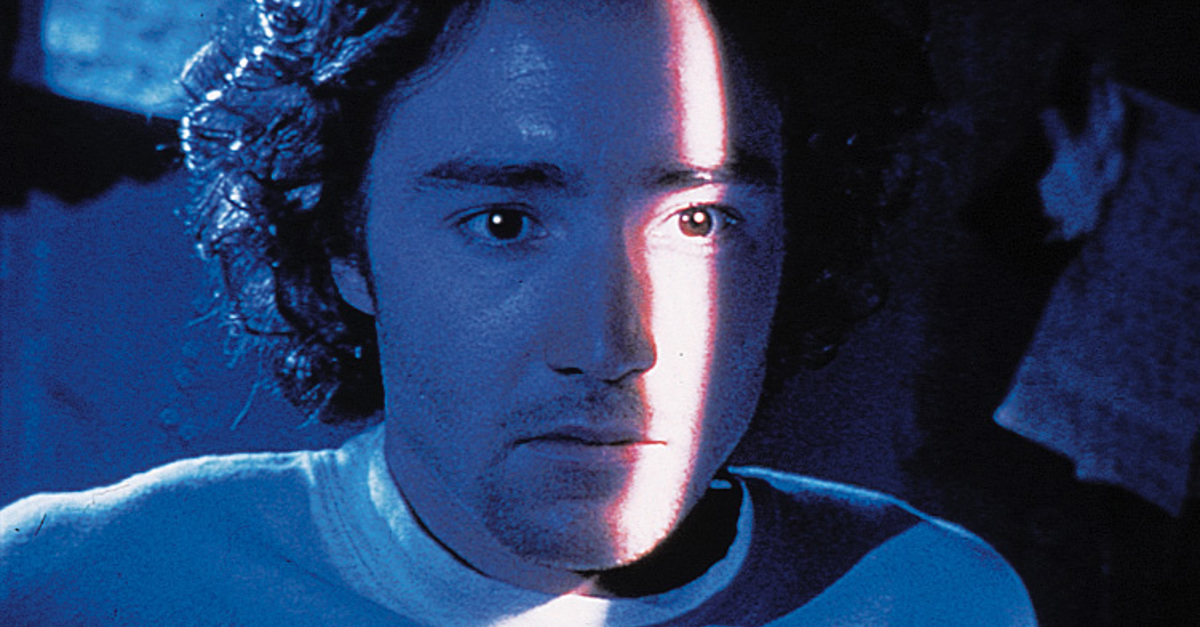
Undeniably, Scott Reynolds has style. There are often striking images of Rebecca Hobbs literally following Paolo Rotondo back into the past; of posters and knives from the flashbacks suddenly appearing in the cell; the spooky appearances of the Visitors with green bleeding mouths; and one wonderful image of Jennifer Ward-Leland’s mother waiting for the young Simon to return home in the doorway of a house that is backlit red.
Yet for all Scott Reynolds’ style and his appropriation of the subliminal flashes, partial glimpses and cut-up style pioneered by Se7en (1995), The Ugly is a film of surprisingly little effect. Reynolds wants to make a horror film – but hardly ever engages us in horror or tension. There is only a single sequence where he does – where Paolo Rotondo hides in Vanessa Byrnes’ bathroom just as she returns home and we not sure whether she is going to enter the bathroom or whether he is going to jump out and kill her.
Moreover, Reynolds’ desire to impress with flashy visual tricks ends up swamping the film. They get in the way of even basic credibility – it is impossible to accept that the psychiatric hospital portrayed is one that could ever exist in the real world – any hospital that had debris and broken lights strewn through its hallways and bullying guards who had dirty dreads, bare chests and a sullen attitude, or even where lights have for some reason been placed under the seat cushions in the waiting room would surely be closed down by the authorities without even a question. For no particularly clear reason, all the blood shed in the film is coloured green. Reynolds throws in flash fantasies of people killing one another – although it is never clear which character’s mind these are taking place in. The random flips between past, present and fantasy entirely corrode any sense of narrative coherence. Case in point is the climax where Rebecca Hobbs’s character is seemingly murdered but one leaves the film unsure whether it was real, a dream or what.
In the end, The Ugly is a frustrating and disappointing film because Scott Reynolds does have promise and the film could have worked if Reynolds’ visuals had been connected to a strong story. It is just that he needs to learn his weaknesses – the primary one being that he needs to work in conjunction with a good scriptwriter. That said, Reynolds improved considerably with his next two films – the imaginative clairvoyance film Heaven (1998) and the fine and underrated psycho-thriller When Strangers Appear (2001). Alas, that is all we have seen of him to date with his late screen credit being writing additional dialogue on the South Korean Wu Xia/Western The Warrior’s Way (2010).