
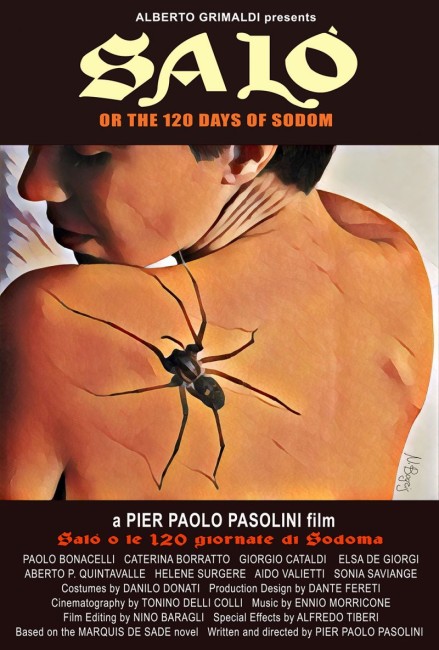
(Salo le 120 Giornate di Sodoma)
Italy/France. 1975.
Crew
Director – Pier Paolo Pasolini, Screenplay – Pier Paolo Pasolini & Sergio Citti, Based on the Novel 120 Days of Sodom by the Marquis de Sade, Producer – Alberto Grimaldi, Photography – Tonino Delli Colli, Music – Ennio Morricone, Production Design – Dante Ferretti. Production Company – Produzioni Europee Associati/Les Productions Artistes Associes.
Cast
Aldo Valletti (The President), Paolo Bonacelli (The Duke), Elsa De Giorgi (Signora Maggi), Giorgio Cataldi (The Bishop), Umberto Paolo Quintavalle (Curval the Magistrate), Helene Sugere (Signora Vaccari)
Plot
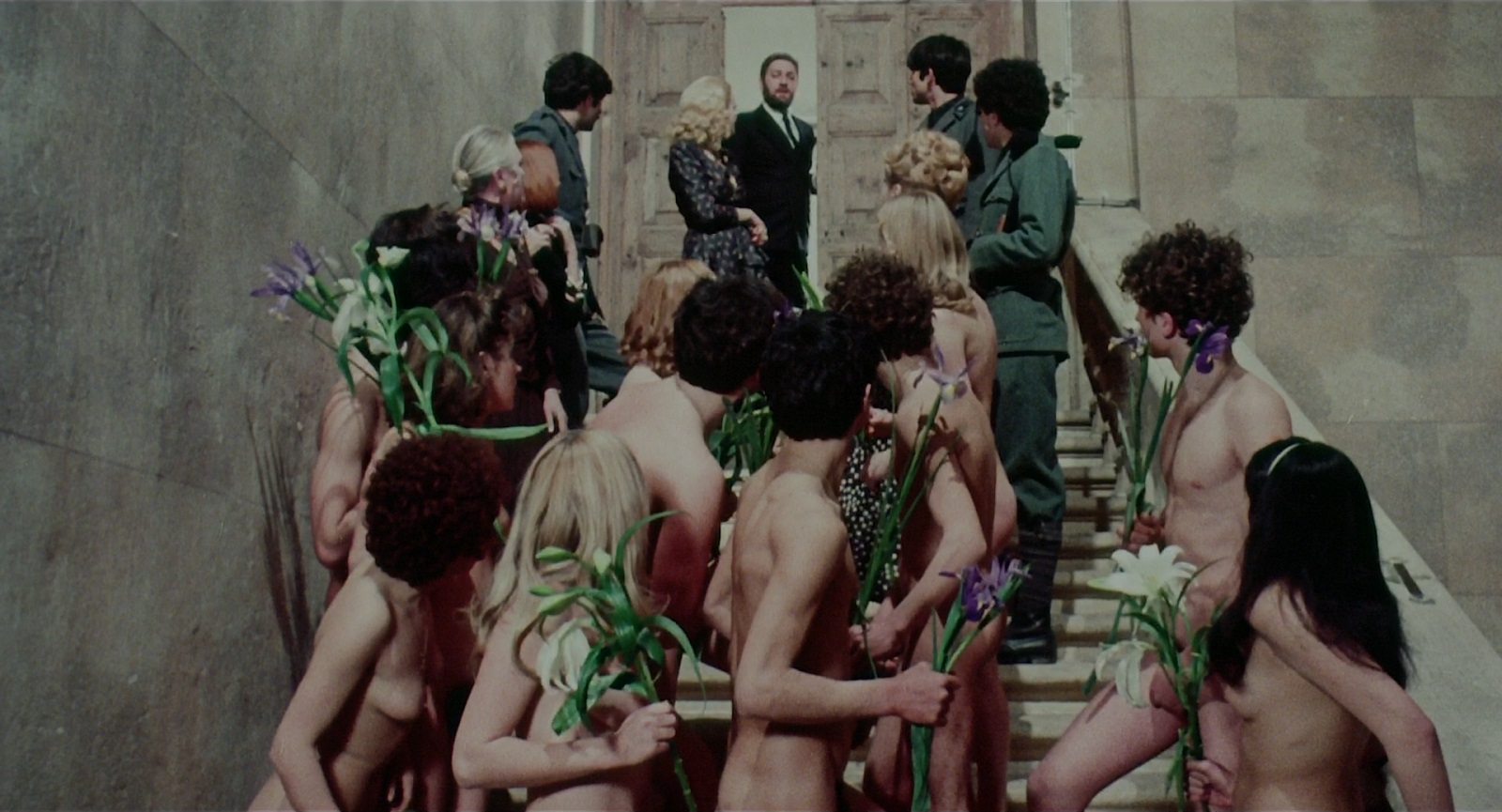
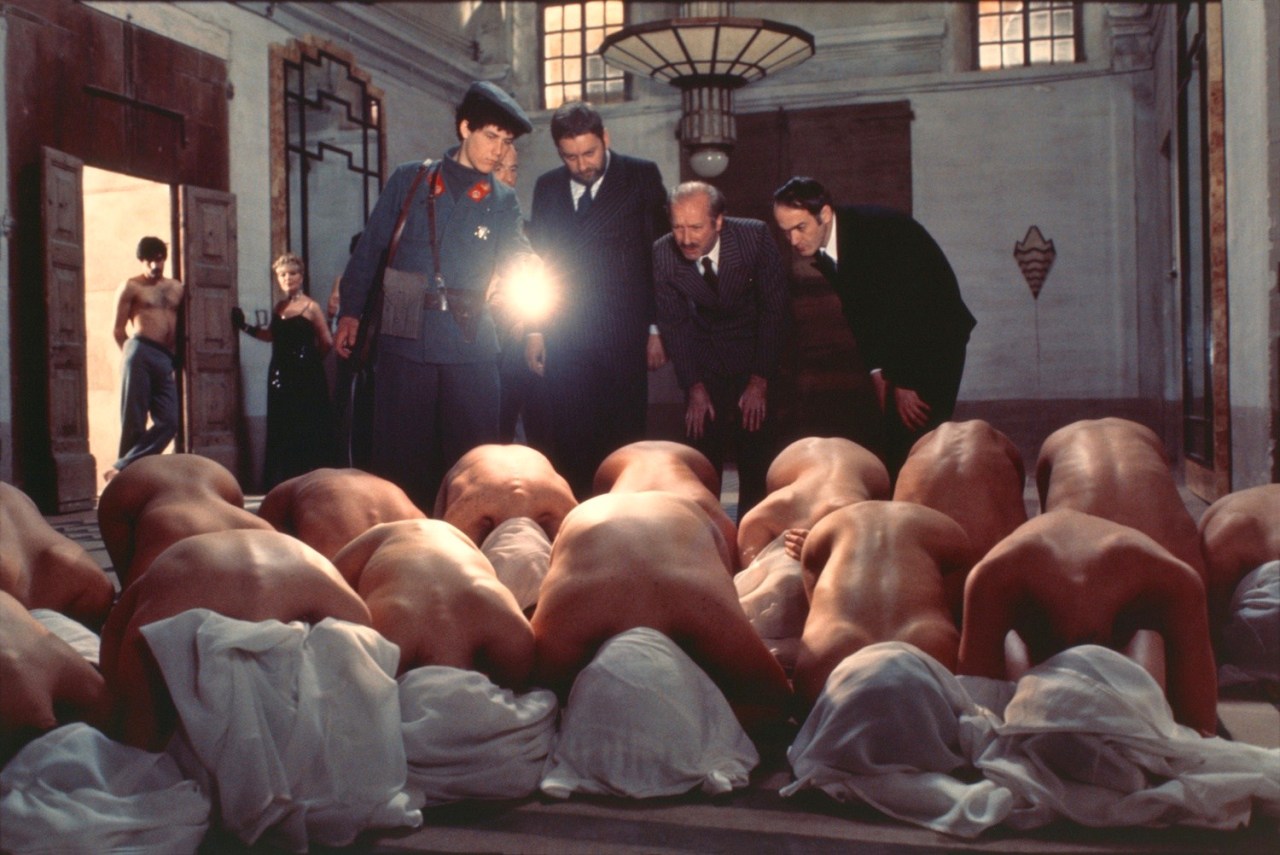
In the town of Salo in Northern Italy during the Fascist rule of 1944-5, community leaders abduct a group of virgin boys and girls and take them to a villa. There the youths are held naked so that the leaders might indulge the most depraved human vices.
120 Days of Sodom is a work of pornography from the Marquis de Sade (1740-1814), the man who lent his name to the phrase ‘sadism’. The original work was written by de Sade while imprisoned in The Bastille from 1784-1789 and finished, it is believed, in 1785. The manuscript was never completed by de Sade and was stolen during the sacking of the Bastille in the midst of the French Revolution around 1789. The original manuscript was never known to exist until the late 1800s where it was found in the estate of the Marquis de Villeneuve-Trans. A heavily censored version was first published in 1904 (and limited only to doctors and legal professionals!) while the full work did not see the light of a printing press until 1935. (The text can be easily found online these days).
This screen adaptation of 120 Days of Sodom was made by Italian filmmaker Pier Paolo Pasolini. Pasolini was a highly controversial figure – he was an avowed Communist and socialist during the War and was an open homosexual. Pasolini’s first film was Accatone (1961) and the first of his works to mire him in controversy with its portrait of the life of a pimp. Pasolini emerged into wider public attention with The Gospel According to St Matthew (1964), a film backed by the Catholic Church and widely regarded as one of the best works on the life of Christ, even though Pasolini was an avowed atheist.
The works that Pasolini became most associated with were his adaptations of classics and/or works of open sexuality (often frankly talking about homosexuality), which include Oedipus Rex (1967), The Decameron (1971) and The Canterbury Tales (1972). Salo or 120 Days of Sodom would be Pasolini’s last film – he was murdered shortly after completing it by a young male prostitute he had dallied with who drove Pasolini over in his own car.
With Salo or 120 Days of Sodom, Pier Paolo Pasolini updates de Sade from early 18th Century France to Fascist Italy. (Indeed, Salo is an Italian province where Pasolini spent parts of his childhood and had witnessed first hand the mindless thuggery of Mussolini’s fascists). In Pasolini’s view, de Sade’s work, which was essentially a work of pornography, takes on an added political dimension to talk about the corruption of absolute power. Outside of this, Pasolini remains faithful to the text of de Sade’s work, replicating the depravities and the structure of the nightly tales told by the gathered guests. Salo or 120 Days of Sodom is certainly Pasolini’s most controversial work and still remains banned in many countries of the world after more than two decades.
Writing criticism in the horror genre often leaves one feeling jaded about the genre’s capacity to shock and disturb. Salo or 120 Days of Sodom is one of the first films in some time that held the capacity to disturb this viewer. If one measures a film’s success in terms of the ratio between the emotional response it sets out to generate against the response it does achieve then Salo may well be one of the most effective films ever made.
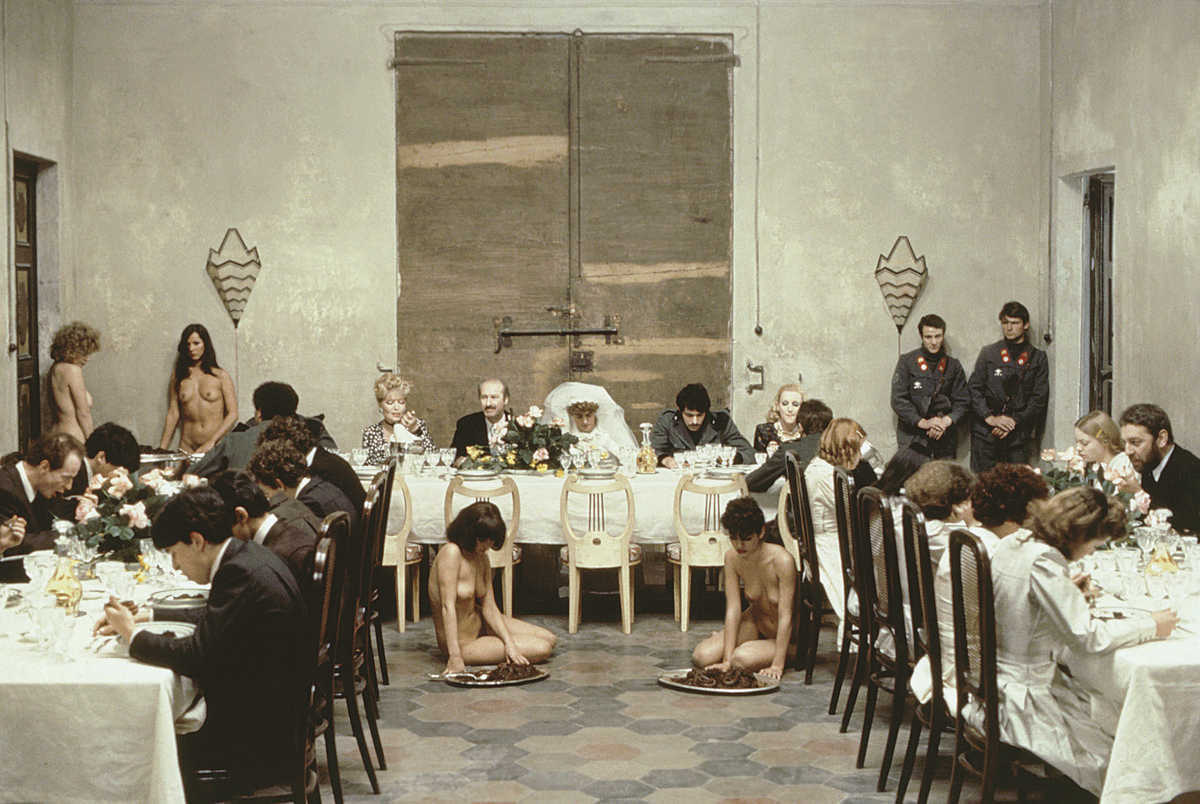
There are times it is a genuinely shocking film. The scenes with excrement being served up at a banquet table and people taking delight in eating it are guaranteed to turn one’s stomach. There is a scene where the duke squats, defecates on the floor and then by verbal abuse forces a naked girl to eat his excrement with a spoon that makes one flinch.
The final segment, entitled The Circle of Blood, is a descent into full-on horror filled with disturbingly realistic scenes of people being raped and then hung, candles applied to nipples and genitalia, eyeballs being gouged out, scalps peeled back and tongues cut out – one of the few sequences in a film that almost became unwatchable for this viewer. Certainly, many among the audience walked out at this point. The film’s depiction of the extremes of human degradation is radical. If any film ever surpasses Salo‘s extremes in future, one is not sure if they want to see it.
Whether Salo or 120 Days of Sodom is a work of art is an entirely different question. It is a film that squarely defies any pigeonholing in this regard. It never offers a moral point of view about what is being shown – the acts of sadism and degradation depicted are certainly not shown in any erotic light nor in any way that appears to celebrate them but at the same time the film takes a neutral distance and by the very fact that the camera remains squarely focused on what is happening, recording acts of genuine debasement and seeming to exist solely to parade them before us, it forces to accept them as art and in so doing question the meaning of a work of art. The result is a phenomenally powerful and disturbing film.
Pasolini was known for casting amateurs. Even given such, some of the performances in the film are good, especially Aldo Valletti as the president. Valletti is a mousy figure with cross-eyes and a seemingly mindless smile, which seems all the more disturbing when he is conducting some of the extreme acts the film requires. The expression of joy on his face as he is buggared by one of his own soldiers is rather alarming.
Pier Paolo Pasolini’s other films of genre interest include;- Teorema (1968), which stars Terence Stamp as possibly divine visitor who appears and seduces all the members of a family; Medea (1969) retelling the story of Jason and the Argonauts; the strange and rather incomprehensible Porcile (1969), one story of which concerns the activities of a cannibal; and the beautiful and erotic adaptation of Arabian Nights (1974). Abel Ferrara’s Pasolini (2014), featuring Willem Dafoe as Pasolini, and the Italian-made The Machination (2016) are biopics that centre around Paolini’s death.
Trailer here