

Crew
Director – Albert Band, Screenplay – Louis Garfinkle, Producers – Albert Band & Louis Garfinkle, Photography (b&w) – Frederick Gately, Music – Gerald Fried, Visual Design – E. Vorkapich. Production Company – Maxim Productions.
Cast
Richard Boone (Robert Kraft), Theodore Bikel (Andrew McKee), Howard Smith (George Kraft), Robert Osterloh (Lieutenant Clayborne), Herbert Anderson (Jessup), Peggy Maurer (Ann Craig)
Plot
As a member of the board of governors, Robert Kraft is appointed custodianship of the Immortal Hills cemetery. On the map on the wall in the cemetery office, the plots that are already occupied are marked by black pins and those that have been purchased by customers who have not yet died with a white pin. Kraft then finds that when he accidentally places a black pin in an as-yet unoccupied plot on the map he has the power to cause that person to die.
I Bury the Living is a fascinating find. These days its novelty rests on the fact that it was a horror film starring Richard Boone, best known as the star of the tv series Have Gun, Will Travel (1957-63). Among genre names, it is also interesting for being directed by Albert Band, the father of Charles Band, together of whom would form Empire Productions and Full Moon Productions during the 1980s and 90s, making almost exclusively low-budget science-fiction, horror and fantasy films, including the likes of Trancers (1985), Re-Animator (1985), Puppetmaster (1989) and numerous sequels to such.
Once one gets past the lurid poster title that I Bury the Living has been sold with, Albert Band develops a fascinatingly stark atmosphere. The film has a unique one idea premise – one that could easily have served as an episode of The Twilight Zone (1959-63) – of a man who develops the power to cause people to die by pushing pins into a map of the cemetery.
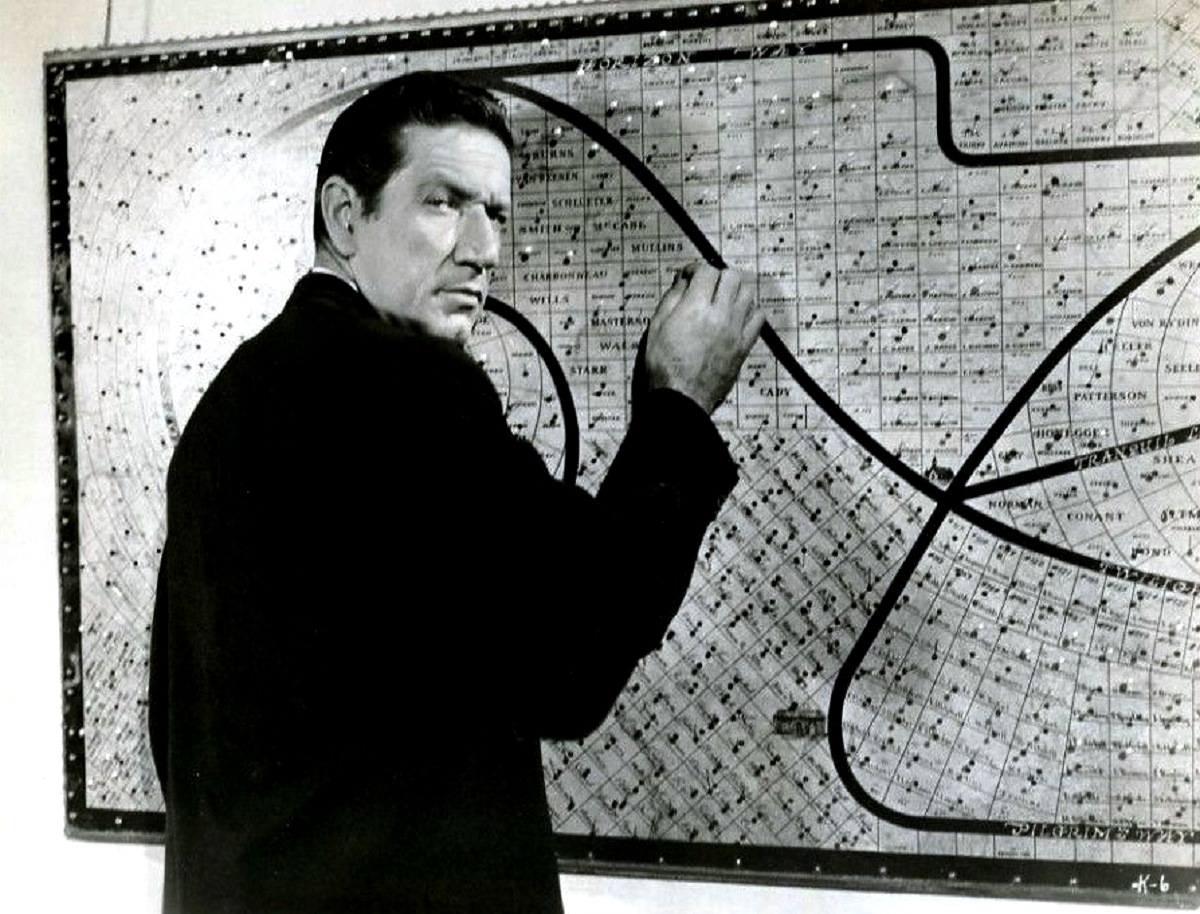
Stylistically, Band has modeled the film on 1940s film noir. The film develops to where it becomes almost a single-set play that takes place in the graveyard office that is dominated by the giant map of the cemetery plots and eventually becomes backlit as the atmosphere develops. Band develops such an intensively shadowy and haunted tension that when a mundane, non-supernatural resolution is eventually reached it seems an uneasy jolt that is not believable and where the supernatural seems to sit much easier under the circumstances. The film’s intensity and atmosphere however is quite memorable.
Into the 1980s, director Albert Band became a prolific producer of low-budget video-released sf and horror films. He founded both Empire Films and Full Moon Productions. Under these labels, both he and his son Charles oversaw the likes of the Ghoulies, Trancers, Puppetmaster and Prehysteria! series of films, among numerous others. As director, Albert Band only made a handful of other films including genre entries such as Zoltan … Hound of Dracula/Dracula’s Dog (1978), Ghoulies II (1987), Doctor Mordrid (1992), Robot Wars (1993), Prehysteria! (1993) and Prehysteria! 2 (1994).