

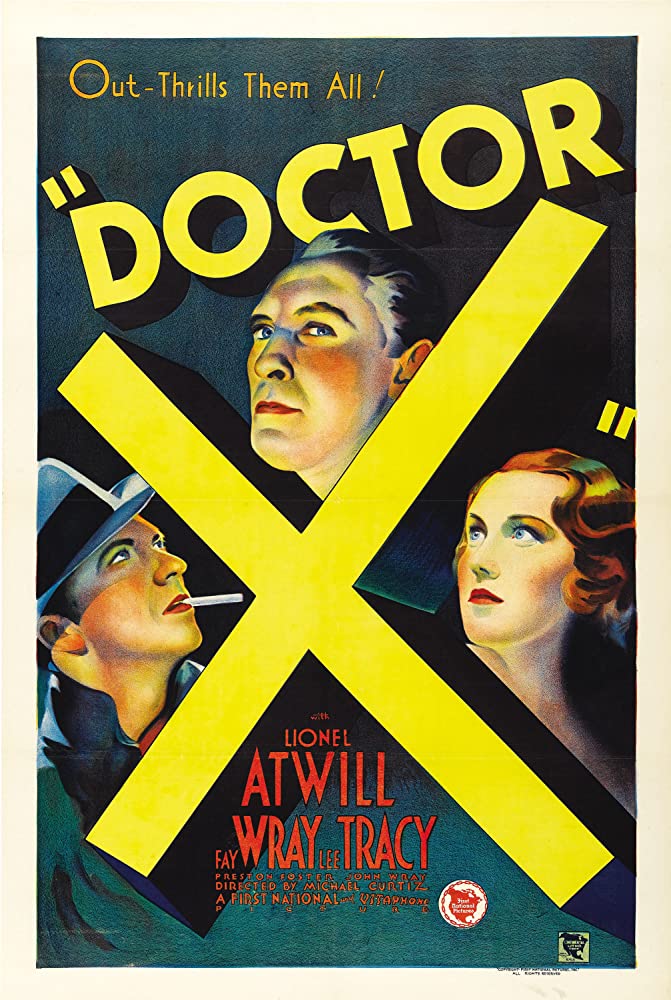
USA. 1932.
Crew
Director – Michael Curtiz, Screenplay – Earl Baldwin & Robert Tasker, Story – Allen C. Miller, Based on the Play by Howard W. Comstock, Photography – Ray Rennahan, Music – Leo F. Forbstein, Art Direction – Anton Grot. Production Company – First National Pictures.
Cast
Lionel Atwill (Dr Xavier), Lee Tracy (Lee Taylor), Fay Wray (Joanne Xavier), Preston Foster (Dr Wells), John Wray (Dr Haines), Harry Beresford (Dr Duke), Arthur Edmund Carewe (Dr Rowitz), Leila Bennett (Mamie), George Rosener (Otto), Robert Warwick (Commissioner Stevens), Willard Robertson (Detective O’Halloran)
Plot
Police investigate the latest of the Full Moon Murders where victims have been cut up and cannibalised, always on the night of a full moon. The knife used in the killings is a special surgical knife, which is traced to the nearby Academy of Surgical Research. The Academy’s head Dr Xavier is certain that the killer is one of the scientists that work there and that he can trap him using an elaborate device that measures pulmonary response. Allowed only 48 hours to prove his case by the police, Xavier gathers the Academy’s scientists at his gloomy Long Island mansion and stages a re-enactment of the murders with the scientists hooked up to his gadgetry. However, the lurking murderer strikes in the midst of the experiment.
Doctor X is one of the classics of 1930s horror cinema and an integral cornerstone of the mad scientist genre. It is without any doubt a classic, although it is more of a whodunnit rather than it ever conforms to any of the generic tropes that would later be identified with the mad scientist film. This makes it different in many ways from the other mad scientist films of the era – for one, the title scientist is a good guy rather than a deranged madman defying provinces of forbidden knowledge. Furthermore, the scientist places his fantastical super-science apparatus toward the apprehension of the killer rather than unleashing monsters.
Despite this, Doctor X still manages to boil a wonderfully torrid pot of horror elements – a cannibal killer; a gloomy cliffside Long Island mansion with sinister retainers; a lineup of suspicious scientists – one with a missing arm conducting a study on cannibalism, another whose companion vanished under mysterious circumstances in the South Seas, and a wheelchair-ridden one who can rise to his feet under moments of hysteria.
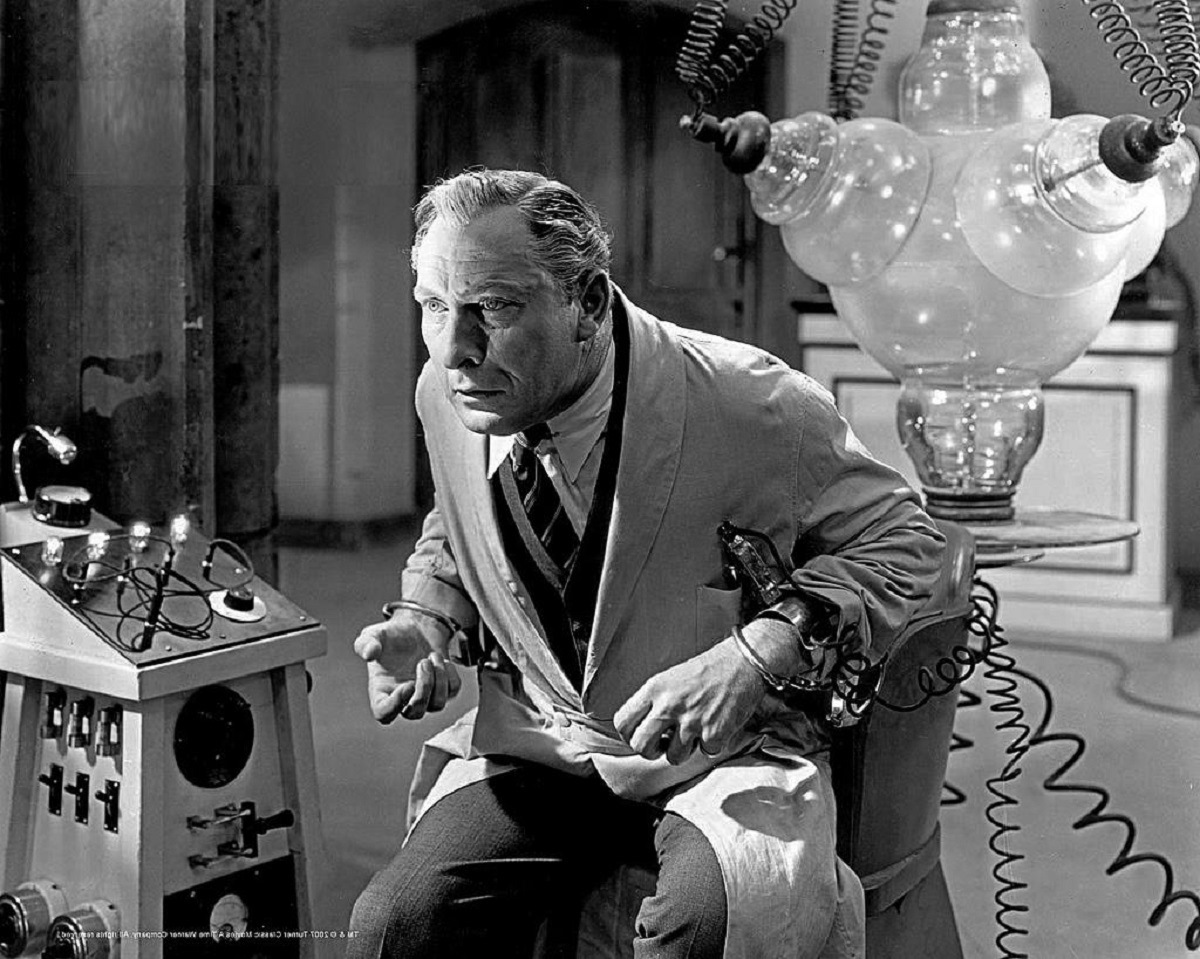
There is a wonderfully lunatic scheme by Lionel Atwill to re-enact the murder with the scientists chained to their seats and wired to a giant device that will measure the buried psychological triggers that drives one of them to become a killer where their invigorated heart rate will cause a blood-like substance to rise up through ten-foot tall tubes (sort of an extraordinarily OTT lie detector). The re-enactment with low-lit closeups on the parties’ faces, the thrill of seeing such an extravagant pulp super-science device in action and a surprise twist wherein the murderer attacks during the re-enactment is superb.
The climactic twist revelation of the killer’s identity where we see him attaching a hand made of artificial flesh to himself and smearing his whole head with clay is great. The only downside of the film is the inane comic relief with the practical-joking reporter character played by Lee Tracey.
Doctor X introduced the great Lionel Atwill to the world and made him a genre star up until his death in 1946. Atwill was usually cast as a mad scientist or deranged killer in the likes of Murders in the Zoo (1933), Mystery of the Wax Museum (1933), The Vampire Bat (1933), Man Made Monster (1941), The Strange Case of Doctor Rx (1942), The Mad Doctor of Market Street (1942), and of course his unforgettable role as the wooden-armed police inspector in Son of Frankenstein (1939). In Doctor X, Atwill cuts a wonderfully cool and authoritative presence. In fact, it is of some surprise in light of Atwill’s later career that, despite the film naming itself after his character, he does not turn out to be the killer.
The Return of Dr X (1939) was a loose sequel and is a routine mad scientist effort whose only distinction is in seeing Humphrey Bogart play a vampire.
Michael Curtiz made several other ventures into horror with a lost version of Alraune (1918) in his native Hungary and the Hollywood films The Mad Genius (1931), Mystery of the Wax Museum (1933) and The Walking Dead (1936). He is best known for Hollywood classics such as Captain Blood (1935), The Adventures of Robin Hood (1938) and Casablanca (1942).
Trailer here