
Crew
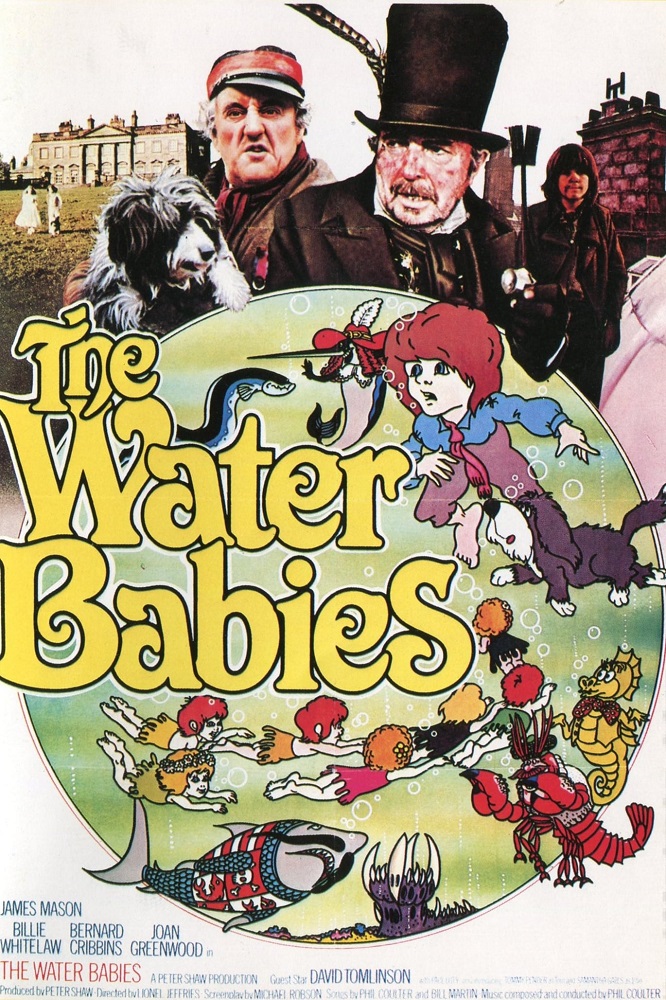
Director/Additional Screenplay Material – Lionel Jeffries, Screenplay/Producer – Peter Shaw, Based on the Novel The Water-Babies: A Fairy Tale for a Land Baby by Charles Kingsley, Additional Animation Dialogue – Denis Norden, Photography – Ted Scarfe, Music – Phil Coulter, Songs – Coulter & Bill Martin, Animation – Film Polski, Animation Supervisors – Tony Cuthbert & Jack Stokes, Art Direction – Herbert Westbrook, Animation Production Design – Cuthbert. Production Company – Peter Shaw.
Cast
Tommy Pender (Thomas Aquinas Something-or-Rather), Samantha Gates (Ellie), James Mason (Grimes), Billie Whitelaw (Mrs Tripp), Bernard Cribbins (Daniel Masterman), David Tomlinson (Sir John Harriott), Joan Greenwood (Lady Harriott)
Voices
Jon Pertwee, Olive Gregg, Lance Percival, David Jason, Cass Allen, Liz Proud, Una Stubbs
Plot
England, 1850. The street urchin Tommy is taken by his bullying employer Grimes to clean the chimneys at Harthove Hall in Yorkshire. Grimes uses the opportunity to rob the house’s silver. However, when when he is surprised by the owners of the house, he shoves the silver into Tommy’s arms and cries “thief”. Tommy runs scared and falls into the river and is sucked under. Tommy then discovers that he can breathe underwater, as well as talk to the marine life. Seeking to find a means of returning to the surface, he heads upstream to find the water babies, other children who have likewise been swept under. An evil shark then captures the water babies. Tommy must choose whether to return to the surface or whether to relinquish the chance to do so and become the rescuer of the other babies.
This film was based on a Victorian children’s book – The Water Babies: A Fairy Tale for a Land Baby (1863) – written by Anglican clergyman Charles Kingsley. Charles Kingsley seemed an extraordinary individual – he was an ardent supporter of social justice and fought for changes to the impoverished conditions of workers; despite being a man of the cloth, he happily supported the side of Charles Darwin during the controversy over evolution; and became a professor of history at Cambridge, chaplain to Queen Victoria and the Canon of Westminster. Kingsley was a prolific author and sermonist and wrote many political, religious and historic works, along with works of fiction – the most well-known of which was the classic pirate adventure Westward Ho! (1855), although The Water Babies was his only venture into fantasy. The Water Babies was written for Kingsley’s son as a sort of fantasticised Charles Dickens fairytale about Christian virtue and has become a well-liked British children’s classic.
The Water Babies was taken on as a film project by Lionel Jeffries, who was better known as an actor in films such as The First Men in the Moon (1964), Chitty Chitty Bang Bang (1968) and numerous British comedies of the 1960s. Lionel Jeffries had had a huge success in his debut as director with the children’s film The Railway Children (1970). The success of this allowed Jeffries to go onto a modest career as a children’s film director with the likes of the little-seen but highly praised children’s ghost story The Amazing Mr Blunden (1972) and Wombling Free (1977).
There is a charm to The Water Babies. At least during the aboveground scenes, Lionel Jeffries successfully plumbs a Dickensian sense of vagabond romanticism with considerable élan. Both Jeffries and Charles Kingsley had strong socialist tendencies and The Water Babies also touches upon some of the darker aspects of Victoriana – working class poverty, child labour conditions. The production values in the live-action scenes are given a good deal of conviction by a nicely gritty sense of period detail.
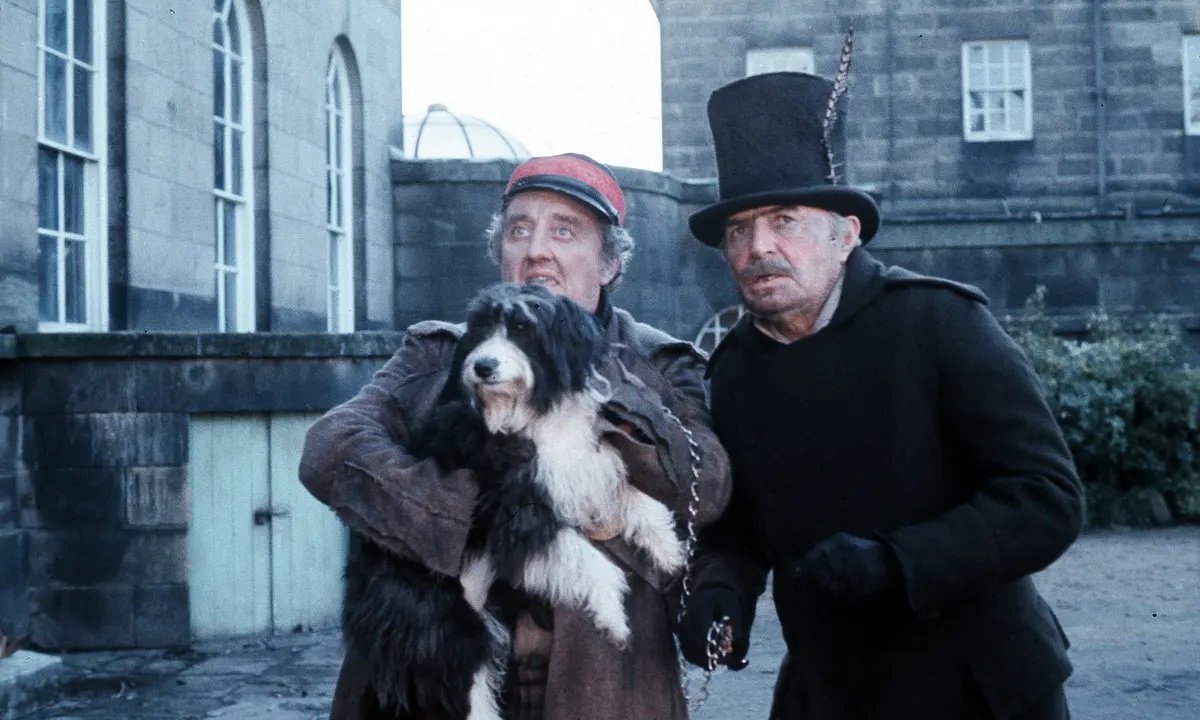
This section of the film is capped by James Mason who plays up the bad-tempered Grimes to fine regard (even if his perfect upper-class elocution seems somewhat out-of-place in such a working class role). The Water Babies also has a decent orchestral score and some passably bland songs.
However, the film loses its grip when it comes to the underwater scenes. For one it becomes animated during these scenes, leaving its gritty bittersweet street waif drama behind for the caricatured surrealism of cartoon slapstick. The nicely bantered aboveground dialogue gives way to something that feels like it has been written by a entirely different author altogether.
Many questions are left explained. The issues of Tommy’s water baby origin is ignored, so too who or what Mrs Tripp is. One also kept wondering what the big deal about Tommy not being able to return to the surface was – why can he not simply swim back up (he seems easily able to ascend to the surface later in the piece by walking up the ice ladder to the polar kingdom)?
Film online in several parts beginning here:-