
Crew
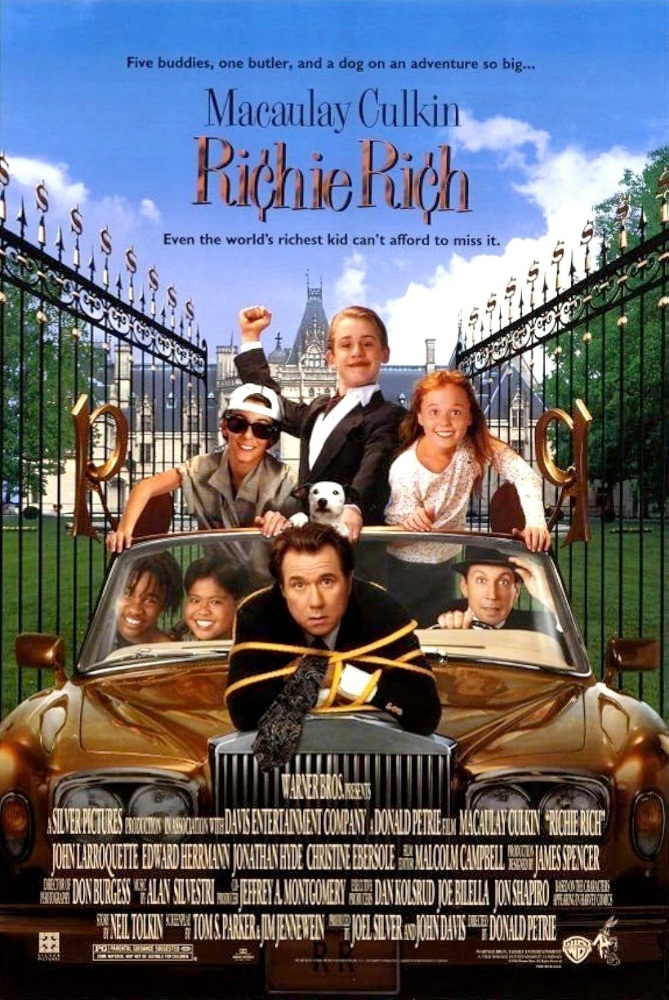
Director – Donald Petrie, Screenplay – Jim Jennewein & Tom S. Parker, Story – Neil Tolkin, Based on the Richie Rich Comic Book Created by Harvey Comics, Producers – John Davis & Joel Silver, Photography – Don Burgess, Music – Alan Silvestri, Production Design – James Spencer. Production Company – Silver Pictures/Davis Entertainment Co.
Cast
Macaulay Culkin (Richie Rich), Jonathan Hyde (Herbert Cadbury), John Larroquette (Lawrence Van Dough), Edward Herrmann (Richard Rich), Christine Ebersole (Regina Rich), Michael McShane (Professor Keenbean), Mariangela Pino (Diane Kazinski), Chelcie Ross (Ferguson), Stephi Lineburg (Gloria Kazinski), Joel Robinson (Omar), Michael Maccarone (Tony), Jonathan Hilario (Pee-Wee)
Plot
Richie Rich, the only child of billionaire parents, is the richest kid in the world. What Richie longs for most of all is friends, especially after a group of poor kids playing baseball near one of the Rich factories reject him as not being of their kind. The butler Cadbury suggests that Richie stay behind while his parents take a trip to England. He then surprises Richie with a visit by the kids from the factory (whom he has actually paid to come). However, Mr Rich’s scheming vice president Lawrence Van Dough has planted a bomb in the Rich’s plane and it goes off, causing them to crash at sea. Richie is sure that they are alive and that he can find them using the computerised Dad Finder. As Van Dough takes over the corporation and starts making ruthless cuts, Richie steps in to take over and makes a roaring success of the business. Meanwhile, Van Dough schemes to regain control by having Cadbury framed and jailed for the murder of the Richs. He then petitions to adopt Richie, whereupon he makes him a prisoner in the Rich mansion.
Richie Rich is probably one of the most famous American children’s comic book characters in the world (at least non-superpowered characters). The Poor Little Rich Boy first appeared in Harvey Comics in 1953 and gained his own comic-book in 1960. Richie Rich’s popularity grew immensely and he was published in a number of titles, before finally being cancelled in 1994 (ironically the same year that this movie version came out). Richie Rich had been incarnated on the screen before in the animated The Richie Rich/Scooby Doon Hour (1980-2) from Hanna-Barbera, where he was voiced by Sparky Marcus.
This live-action film version of Richie Rich was mounted by no less than a pairing of John Davis, producer of the Predator films and Waterworld (1995), and Joel Silver, producer of action films like the Lethal Weapon series, Die Hard (1988) and The Matrix (1999). Richie Rich has been largely construed as a vehicle for Macaulay Culkin who was the most successful child star in the world at the time that the film was made. Predictably during the last quarter of the film, Richie Rich turns into a variation on Macaulay Culkin’s signature vehicle Home Alone (1990) with Culkin and friends leading an attack on the mansion and the one-dimensional villains undergoing various slapstick pratfalls and humiliations. Indeed, Richie Rich feels like more like a vehicle for the precociously annoying Macaulay Culkin than it ever is an adaptation of the comic-book.
Certainly the various characters of the comic-book – Cadbury the butler, Dollar the dog, Professor Keenbean – are all there. On the other hand, a good deal of modern humour tends to intrude – jokes about cute butts, Richie lusting over Claudia Schiffer in a cameo as an exercise instructor – which disrupt the innocence that the comic-book had. The comic-book was always a parody of excess wealth – where Richie had vaults filled with money that stretched as far as one could see, dressed in clothes and slept in sheets embossed with dollar signs, even had a dog with dollar markings on its fur – but the film rarely attains that. One scene where it does is the classroom where instead of school desks pupils sit at executive office desks, play office golf during lessons and fax instead of pass notes to the person at the next desk.
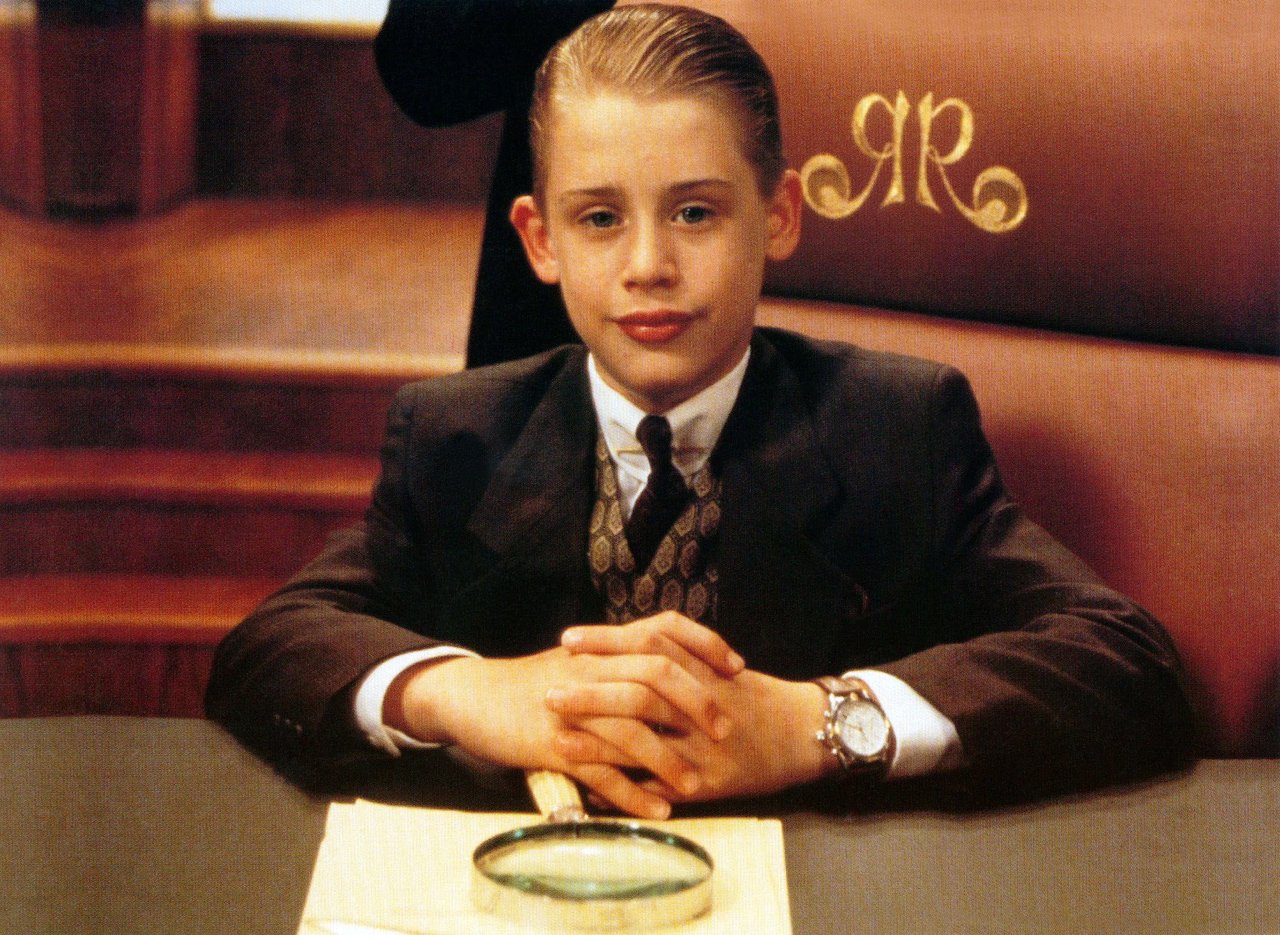
While the comic-book was a fantasy of hyper-capitalism and excess consumption, one tends to feel that the very act of giving such a fantasy three-dimensional life rudely and abruptly punctures the balloon that the comic-book existed in. The comic-book existed in a world where the realities that came with attaining wealth such as labour under-classes necessary to support such capital production, class disparity and a world where the other extreme (poverty) exists never entered into its sphere of comprehension. All of these are present in the film.
However, with the film being made in the 1990s, a time when the wealth divide and social disenfranchisement was growing in America and where hyper-capitalism was rent by ugly truths about ruthless corporate greed, asset stripping and third world sweatshops, not during the 1950s/60s when the comic-book appeared and America was living in a post-War boom and such a fantasy seemed an amusing extension of what was conceivable, Richie Rich cannot help but seem smug in its attempt to create a fantasy of excess consumption. The film sort of tries to make a distinction between John Laroquette’s one-dimensional villain who represents naked greed and Mr Rich who operates on a principle of personal decency, although is hardly convincing.
Richie Rich’s Christmas Wish (1998) was a video-released sequel. Subsequent to the film, Richie Rich was also spun out in a short-lived animated series Richie Rich (1996-7).
Director Donald Petrie has made various other comedies such as Grumpy Old Men (1993), The Associate (1996) and Welcome to Mooseport (2004) and Chick Flicks such as Mystic Pizza (1988), The Favor (1994), Miss Congeniality (2000), How to Lose a Guy in 10 Days (2003) and My Life in Ruins (2009). Donald Petrie’s other genre efforts are the dismal remake of tv’s My Favorite Martian (1999) and the majorly unfunny Lindsay Lohan teen comedy Just My Luck (2006).