

(Rakkaus On Aarre)
Finland. 2002.
Crew
Director/Screenplay – Eija-Liisa Ahtila, Producer – Iippo Pohjola, Photography – Arto Kalvanto, Digital Effects Supervisor – Tuomo Hintikka, Production Design – Tiina Paavilainen. Production Company – Crystal Eye-Kristallisiima Oy.
Cast
The Women: Underworld – Amira Khalifa; Ground Control – Ullariika Koskela; Silta Bridge – Minttu Mustakallio; Wind – Marjaana Kuusniemi; House – Marjaana Maijala
Plot
Underworld:- A patient in a psychiatric hospital believes that the orderlies coming for her are assassins and hides under her bed where she has prepared to fight for her life. Ground Control:- A woman believes that UFOs have contacted her, using coded signals hidden in the flickering of street lights. They tell her how they are the secret protectors of Earth’s environment and have reduced noise levels for human hearing but have granted her special insight because she speaks quietly. Silta Bridge: While crossing a bridge, a mother finds that she can no longer go on and must crawl across. Wind:- A woman living alone in her apartment regularly trashes her belongings and lives amongst the mess. At the same time, strangers keep entering the apartment. House:- A woman living on her own in a house in the country believes that her car outside has a life of its own and is entering the house, and also that time and causality are breaking down and she can hear and see disconnected events.
Love is a Treasure comes from Finnish director Eija-Liisa Ahtila. Although Love is a Treasure is screening at film festivals, Eija-Liisa Ahtila should not be considered so much a film director per se than an artist using the video/film medium. Her previous work, including various short films and photographic works, has tended to screen at galleries and exhibitions rather than in theatres. Indeed, Love is a Treasure originally screened as five separate pieces, each playing on a different monitor in a gallery, and have only been collated and presented end-to-end as a single 55 minute film for theatrical screening here.
One of Eija-Liisa Ahtila’s exhibitions was named Real Worlds, Invented Characters and that seems to be an overriding theme that runs through her work, especially this and her previous short film Consolation Service (1999) about a wife haunted by an enigmatic apparition of her late husband. The five stories in Love is a Treasure were all taken from interviews with women diagnosed with mental illness and are designed to offer a point-of-view depiction of psychotic episodes. The intense subjectivity of their point-of-view is clearly a theme that is deeply personal to Ahtila.
The startling reversals inherent in Ahtila’s work are at their most vivid in the Underworld segment. The piece is narrated entirely by an African woman who is hiding under her bed in the belief that assassins have come to get her and even claims to have armed the bed with handles in case they try to lift it off her. The episode is narrated at a pitch of intense calm and it is disconcerting to see that the assassins the narrator believes are coming after her are in fact the nurses in what appears to be a psychiatric institution. It is these startling trompe l’oeil images and of things seen from the point-of-view of the mad person without any explanation of the subjectivity that makes Ahtila’s work so effective.
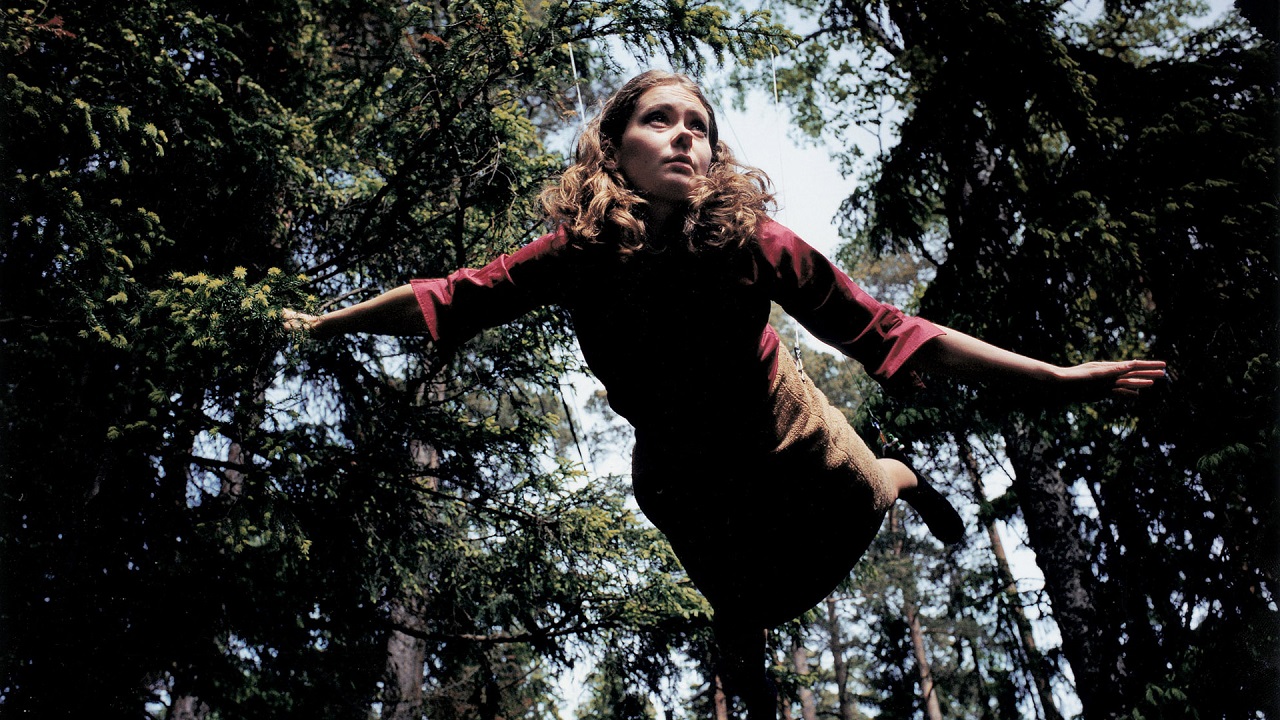
Ahtila intersperses the real with the casually fantastique, using digital effects to subtly enhance things – the pullback from a hospital in Silta Bridge to reveal it is a doll’s house sitting on the corner of an empty lot, the house that has been cut open as though it were a doll’s house, and the ending of Wind where Marjaana Kuusniemi crawls up the wall of her apartment and sits perched on the roof. The best of the segments is House where Ahtila takes one’s breath away with the casualness of her visuals. We see bizarrely startling images like Marjaana Maijala, who in another story might seem a perfectly calm upper middle-class housewife, cowering in her house commenting on how the car is misbehaving – whereupon out in the drive we see the car backing and reversing all of its own accord; and then how she mentions it is in the house and quite casually we see a tiny car whiz in a circle around the walls behind her back.
Of the five episodes, only Ground Control, the most overtly genre-identifying, with its heroine hearing secret messages from the UFOs, is the slightest. The digital UFO effects are so-so and the episode is lacking the startling reversals of imagery that the others contain.
Most of Eija-Liisa Ahtila’s other film work has all been short films. Her one other full-length film was Where is Where? (2009) about the recollection of a murder, which features Death as one of the characters.