

UK. 1989.
Crew
Director/Teleplay – Dennis Potter, Based on His Novel, Producer – Rick McCallum, Photography – Andrew Dunn, Music – Max Harris, Production Design – Geoff Powell. Production Company – BBC.
Cast
Gina Bellman (Blackeyes), Michael Gough (Maurice Kingsley), Carol Royle (Jessica), Nigel Planer (Jeff)
Plot
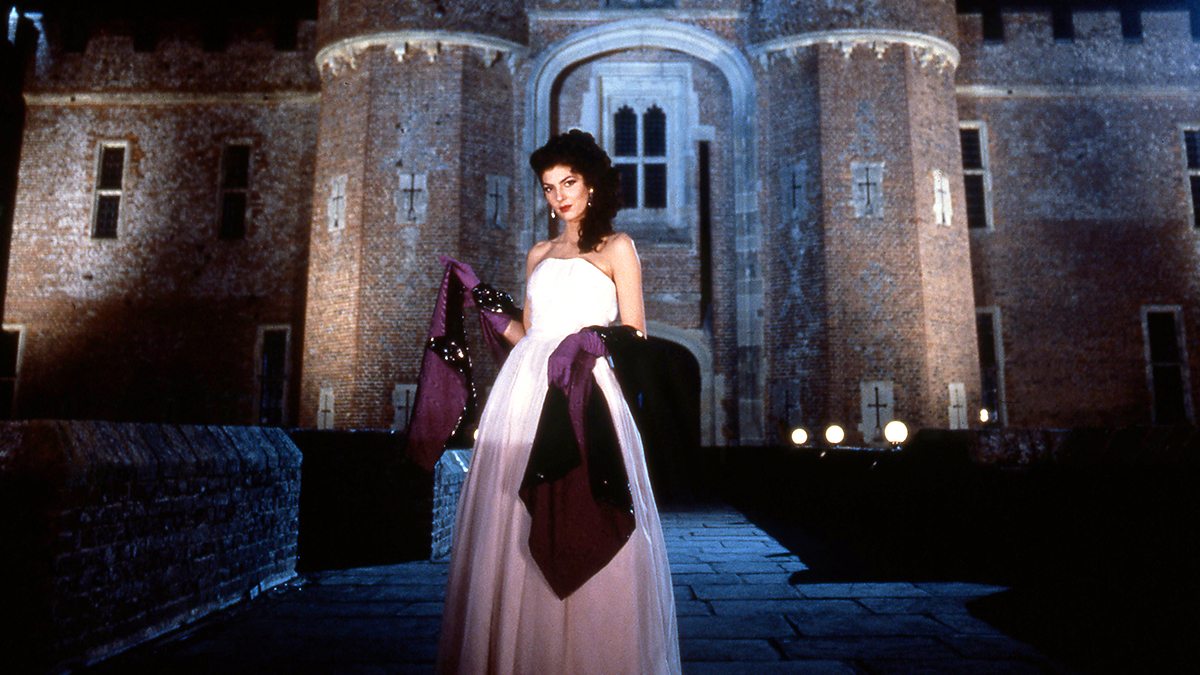
‘Blackeyes’ is a novel written by the aging Maurice Kingsley concerning the sexual travails of the title character in the modelling world. Kingsley has based the book on the experiences of his niece Jessica. When she reads the book, Jessica is horrified at the smutty work that Kingsley has turned her life story into. As she reads, the character of Blackeyes calls out, begging Jessica to deliver her from the life she has been condemned to live.
Dennis Potter (1935-94) is the one truly great writer to emerge out of television, the sole writer the medium has produced whose body of work can stand alongside classics of modern literature. Dennis Potter grew up in the rural area known as The Forest of Dean near England’s border with Wales during World War II (a location and time period that hovers over much of his work). He moved to London with his mother at the age of ten and during this time was subject to sexual abuse from an uncle. Potter graduated from Oxford and began to work for the BBC, as well as publishing books, newspaper articles and even running as an unsuccessful candidate for the British Labour Party in the 1964 General Election. Potter was also a lifelong sufferer of the crippling condition of psoriatic arthropy. These elements of biography are woven throughout his fiction.
From the late 1960s on, Potter began to throw himself into writing for television, producing a great body of tv plays, mini-series and occasionally movies. These included the likes of The Mayor of Casterbridge (1978), Pennies from Heaven (1978), Blue Remembered Hills (1979), Dreamchild (1985), The Singing Detective (1986), Track 29 (1988), Lipstick on Your Collar (1993) and Karaoke (1996) to name but the most famous. Potter’s work frequently falls into fantasy where he blurs the lines between daydream and dreamer, fiction and author. He frequently features characters who express themselves in musical daydreams or to whom fantasy and fiction are often more real than the physical world around them. (A list of Dennis Potter’s body of genre works is at the bottom of the page).
Blackeyes holds a fascinating place in the body of Dennis Potter’s work. After the BBC refused to air his play Brimstone and Treacle, which was made in 1976 but not aired until 1987 because of a scene where The Devil rapes a comatose woman, Potter and Kennith Trodd set up their own production company. There they produced Potter’s one undisputed masterpiece, The Singing Detective (1986). Potter received considerable acclaim for The Singing Detective and was invited to work on a number of Hollywood projects. Returning to England, Potter then prepared Blackeyes for the BBC, which was an adaptation of his own 1987 novel. He and Trodd then had a falling out. Potter took control of Blackeyes, replacing Trodd with Rick McCallum (who later went on to produce George Lucas’s Star Wars prequels) and assuming the director’s chair himself after the project was turned down by both Singing Detective director Jon Amiel and Nicolas Roeg, the director of Potter’s Track 29. Alas, Blackeyes premiered to a disastrous reception, with the British press being scathing, leaping on the show’s copious nudity and nicknaming Potter ‘Dirty Den’, even printing cartoons depicting him as a dirty old man.
There is no writer alive, either in print and certainly not in the media, who ever managed to write works that wove together such mesmerising layers of meta-fiction and autobiography as Dennis Potter did. There are few efforts in Potter’s oeuvre that operate on the level of linear narrative – most are complex works that weave the author in as an integral part of the text.
With Blackeyes, Potter on one level tells a smutty story about the exploitation of a beautiful model, while at the same time the central character in the story is communicating to the people outside the story and rebelling against the sexist role that she has been cast in. On another whole level, Potter delves into the psychological undertow of the story and shows us author Michael Gough and how he has modelled the story of Blackeyes on his own niece Jessica. In the same way that Blackeyes rebels against what she is forced into in the story, Jessica, as she reads the story and begins to communicate with Blackeyes, must reach down and confront her own past where her uncle sexually abused her.
The story and its layers of meta-fiction becomes even more extraordinary when one places the series into the context of Dennis Potter’s own life and the making of Blackeyes. Potter often wove elements of his own life into the writing of his works and would even construe stories as active meta-fictional texts. Actress Kika Markham tells the story of how Potter interviewed her for a role in his tv play Double Dare (1976) and then invited her up to a hotel room where he appeared intent on seducing her. He then went away and incorporated elements from what had transpired into the play. The finished Double Dare is a work that operates on two levels – one about a prostitute visiting a client in a hotel, the other about the writer writing the play who interviews an actress for the role of the prostitute in a hotel lobby where the boundaries between the fiction and the conversation keep blurring. (And to blur the line even further, the roles of the actress and prostitute were both played by Markham).
Similarly in Blackeyes, Potter similarly blurred the line between his own life and what we see on screen. Not unlike Michael Gough’s Kingsley, Potter also wrote the work earlier as a novel. More importantly, during the filming, Potter, aged 54, personally wooed his lead actress Gina Bellman, who was only 23 at the time. Bellman recounts how Potter seemed enamoured with her beauty and genuinely believed that he was in love with her, even though she did not return his affections.
Thus, beyond the level of play between fiction and meta-fiction, between the questions of men’s lust and objectification of women as objects, Blackeyes has a real world level to it where the creator of the show, while also critiquing men’s lust up on screen, also seemed deeply smitten with the actress who was portraying his objectified object of lust. As always with a Dennis Potter work, there is the sense that Potter is engaged in a deep and often uncomfortably ugly (yet completely brilliant) act of self-exposure and a Machiavellian gamesmanship where he seemed determined to wind himself in as an active character in his own fiction.
This review of Blackeyes must come with a codifier – it is regrettably an incomplete review. The original mini-series aired on the BBC in four one-hour episodes; the version I have seen is the one that was condensed to 90-minute movie length. (If anyone has a copy of the complete original series, I should dearly love to see it). At this length, the story often seems confusing and incomplete. Nevertheless, a flawed brilliance does shine through.
For all that Blackeyes was attacked as cheap and sordid exploitation by the British press, what does seem to have escaped most of them is that it is a work where Potter is questioning the way that men desire women. Potter was often called sexist but this seems a misreading of his work – he certainly worked his own dual lust and disgust with sex into his work, but seemed more interested in depicting unfulfilled desires than he did in objectifying women. Here at least he appears to have discovered a feminism of sorts.
Dennis Potter’s other genre works are:– the tv play Alice (1965), part an adaptation of Alice in Wonderland (1865), part an examination of the relationship between Lewis Carroll and Alice Liddell; the highly controversial tv play Son of Man (1969), a Passion Play that depicts Jesus Christ as racked with anxiety and doubt; the tv play Angels Are So Few (1970) about a housewife who receives a visit from a man who claims to be angel; the meta-fiction Follow the Yellow Brick Road (1972) where a man believes he is a character in a tv show; the aforementioned Brimstone and Treacle (1976/1987) about a man who claims to be The Devil; the mini-series Pennies from Heaven (1978) concerning Depression-era people who are constantly expressing their inner turmoils in lip-synched musical fantasy sequences; the tv play Blue Remembered Hills (1979) where Potter conducted the unique device of depicting his childhood during the War with adults cast in the roles of children; Pennies from Heaven (1981), the Hollywood remake of the earlier mini-series; Brimstone and Treacle (1982), a film remake of the tv play; Dreamchild (1985) about the life of the aging Alice Liddell; The Singing Detective (1986) where a man in a hospital bed, his buried past and the plot of a cheap detective novel blur together into a dazzling meta-fiction; the bizarrely surreal Track 29 (1988) with Gary Oldman as Theresa Russell’s possibly imaginary lost son; Lipstick on Your Collar (1993) where the people in a government office in the 1950s express their fantasies in musical numbers; the tv play Midnight Movie (1994) where an old horror movie screening on tv and a mysterious unsolved murder in the present blur together; Cold Lazarus (1996), the final work written by Potter where the memories of dead writer are ransacked by the people of the future; and The Singing Detective (2003), the posthumous film adaptation of his tv mini-series.
Mini-series available online beginning with Episode 1 here